Girl Guides
Girl Guide movement was introduced in 1910, with a junior movement originally called Rosebuds starting in 1914. They later changed the title to Brownie Guides.
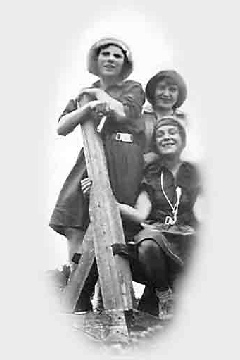
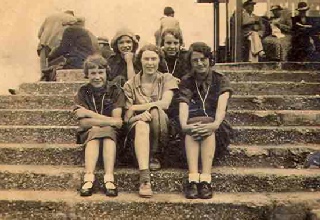
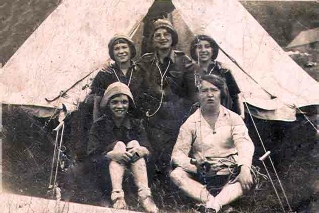
Daisy PRATT was very happy in the guides and enjoyed making her own uniform including her camp hat which was stiffened with sugar water. The five patrol leaders of her company were sent to North Wales with a neighbouring R.C. Company. This gave her a rare break from the domestic chores helping to look after so many little brothers.

Youth Movements.
Boy Scouts
On the census of 1841 several children as young as 9 years can be seen in employment. Unless they were of a wealthy family children had very little leisure time.
In 1883 William Alexander Smith started the interdenominational Christian organisation the Boys Brigade. Soon the movement spread across Britain. from its beginning in Glasgow . It’s aim was to promote “habits of Obedience, Reverence, Discipline, Self-
Lieutenant General Robert Baden Powell was an admirer of the Boys Brigade movement and thought it a good idea to train young boys in scouting skills to enable them to help their community in times of emergency and to prepare them for military service. He had been greatly helped by a group of youths who had carried messages when Baden Powell and his men were trapped in Mafeking. So he took a group of boys to Brownsea Island in 1907 to try out the skills he was to outlined in his book “Scouting for Boys” published fortnightly in six parts. In Scouting for Boys was a series of tests intended to build character and good citizenship in boys aged 11 to 18 years, as well as suggestions for organisation based around the patrol system. The book attracted boys across Britain
In 1909 the first National Scout Rally at Crystal Palace with 11,000 Scouts attending along with a group of girls who declared themselves to be Girl Scouts. Lord Robert Baden-

Wolf Cubs
Edward JOHNSON was a keen Cub Scout in the Pack which met in All Saints Church Stechford he enjoyed the summer camps one in Malvern and another in Sutton Colefield. He revisited the Sutton Colefield site when he took Hazel, then a Girl Guide, to the Baden Powell Centenary World Jamboree held there in 1957.

North Devon Boy Scouts
John Sampson DYMOND [2450].
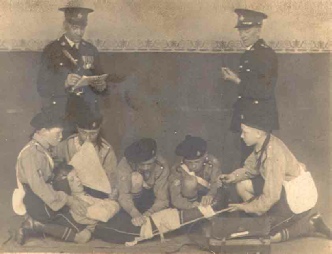
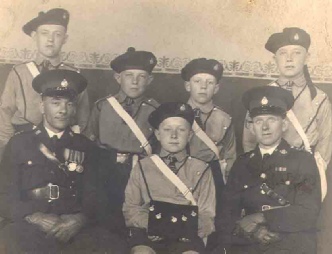
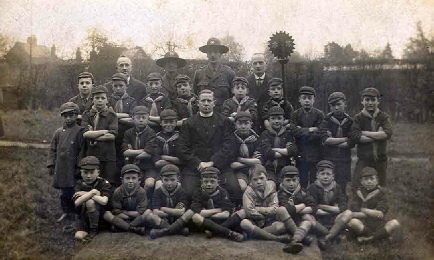
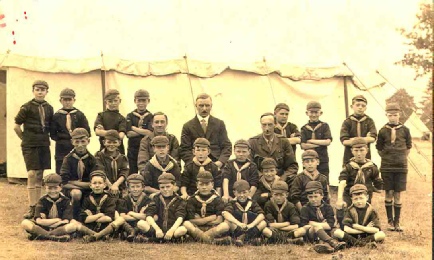
On January 12th 1916 as Chairman of the Bideford Scouts Association he attended an event at the Northam Scout room,
“The Scouts were drawn up and inspected by Mr. J. S. Dymond of Bideford who congratulated them on their smart appearance. The Scouts were then drilled by Scoutmaster Whitton”
The event which was reported with different details in two newspapers the North Devon Journal 20 January 1916 and the Exeter and Plymouth Gazette 21 January 1916, was for the presentation of two large photographs of past members of the troop who had been killed in action.
Sidney KELLY [29795]
One of the photographs. presented to the Northam Troop. was of Lance Corporal Sidney Kelly [10181] of the 8th Battalion, the Devonshire Regiment. Son of Thomas and Ellen Kelly of Cross Street, Northam. Born in Northam in 1896. Died 25 September 1915 aged 19. He was a grand-
The other photograph was of Frederick A. King of the 2nd Devons killed in action at Maricroise, France October 27th 1915 he was 18 years old.
Sadly this was not the first such presentation as it was reported in North Devon Journal 15 April 1915 that a photo had been unveiled of Edward J Currie, Boy 1st Class Royal Navy (J/29890). Killed, aged 17, after HMS Formidable was torpedoed and sunk by U24 off Portland Bill 1st January 1915. He was initially based at HMS Vivid in Plymouth. so they must have been among the first Boy Scouts. The age range for the original members was 11-

Proficiency Badges
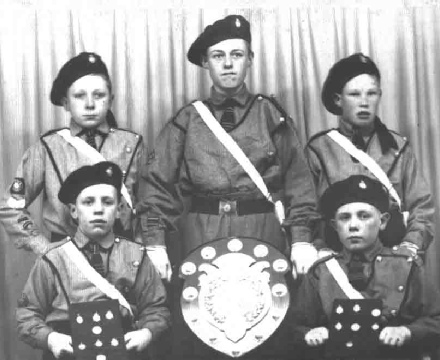
It is interesting to see in Exeter and Plymouth Gazette 21 January 1916 which proficiency badges that the Northam boys had earned in 1916; War Service, Marksman, Laundryman,. Musician, Cook, Horseman, Naturalist,and Missioner. Other badges available in those early days were: Handyman, Blacksmith and Poultry Farmer It is also notable that the boys and their Scoutmaster Whitton earned the War Service badge. (Whitton was awarded his scoutmaster's warrant at the unveiling of Edward Curries photo, even though he was younger than the required age. Many troops found it hard to find adult leaders and many patrol leaders undertook on the work).
Boy Scouts could earn the War Work badge during both world wars, by assisting with coast-